












































Ethereum is currently trading in a sideways pattern, hovering just under the significant $3,000 level. Despite several attempts to break through this psychological barrier, buyers have faced challenges in sustaining upward momentum. The latest price movements indicate a market caught in a state of indecision, characterized by weakening bullish sentiment and a lack of strong selling pressure.
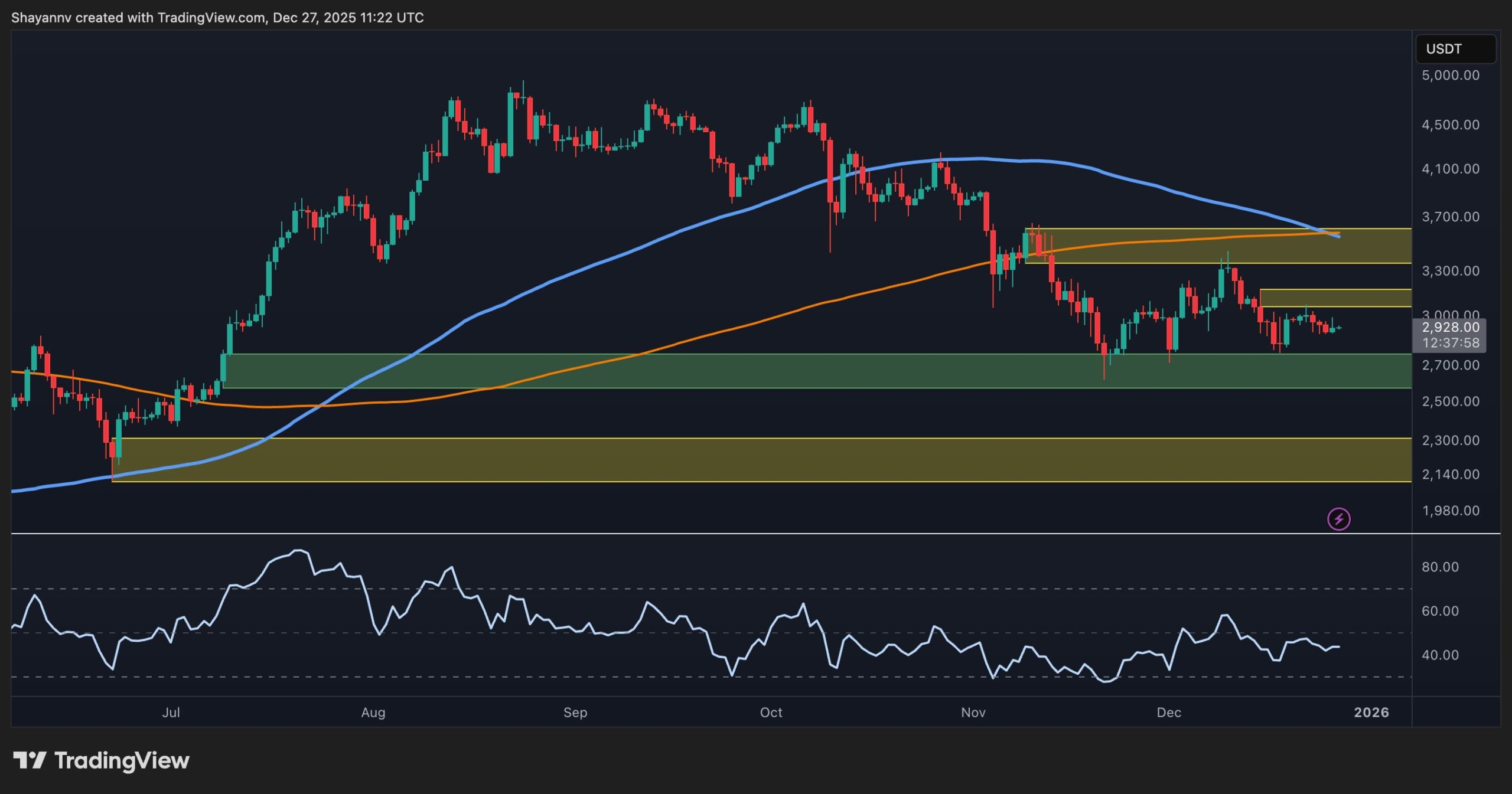
On the daily chart, ETH continues to navigate a consolidation range between the support zone of $2,700 and the resistance level at $3,300. At the time of writing, the price is approximately $2,970. Key indicators such as the 200-day and 100-day exponential moving averages (EMA) are acting as dynamic resistance levels, having recently shown a bearish crossover. This confluence zone just above $3,300 has seen price rejections in the past.
Furthermore, the Relative Strength Index (RSI) remains below the neutral midline, signifying that there has not yet been a shift in momentum favoring buyers. A close below the $2,700 mark could trigger a retest of the macro demand area around $2,200. Conversely, reclaiming the $3,300 level may set the stage for a move towards $3,700 and higher.
In the short term, the 4-hour chart reveals that ETH is still bound within a local trading range between $2,800 and $3,000. The price action has been volatile, reflecting indecision from both buyers and sellers, with failed breakouts in either direction. Although the RSI is showing signs of recovery, suggesting potential short-term gains, buyers need to reclaim the $3,000 to $3,100 supply zone to gain an advantage. A sustained rally above $3,100 could pave the way for a move back to the upper resistance at $3,300, while the current market structure favors range-bound trading.
On-chain analysis indicates notable trends in Ethereum”s exchange reserves. Throughout most of 2025, these reserves have been declining, suggesting a shift towards accumulation or self-custody among holders. This trend is typically viewed as bullish since a reduction in tokens available on exchanges minimizes sell pressure. However, recent data indicates a slight uptick in reserves, marking the first increase in several months.
This uptick could signal that traders are preparing to exit positions amid ongoing consolidation or that larger entities are repositioning for anticipated volatility. If this increase continues, it could imply heightened sell-side activity in the near term. Nonetheless, one data point alone does not alter the long-term accumulation trend. It remains essential to observe whether this uptick is an isolated incident or the precursor to a broader shift in sentiment. Should it coincide with price rejections at resistance and rising open interest, it could confirm a readiness for downside positioning.
As the situation develops, market participants will need to remain vigilant regarding potential breakout scenarios and the implications of on-chain data trends.