











































The currency pair AUD/USD showed signs of strength on Friday as market participants evaluated the wider economic implications of the escalating conflict in the Middle East. The demand for the U.S. dollar, often seen as a safe haven, diminished as oil prices retreated slightly from their recent highs, allowing risk-sensitive currencies like the Australian dollar to recover.
The recent conflict intensified on Thursday when U.S. and Israeli aircraft targeted various sites within Iran, leading to renewed bombardments in Gulf cities. Additionally, reports emerged regarding attacks on oil tankers in the Gulf region, coupled with actions from China to limit fuel exports, which previously drove crude oil prices up by $6 a barrel overnight.
In the wake of these developments, Andrew Hauser, the Deputy Governor of the Reserve Bank of Australia, is set to deliver remarks in New York, which may shed light on Australia”s interest rate outlook and associated inflationary pressures. Market speculation is rife, with investors currently estimating an 80% likelihood that the Reserve Bank of New Zealand will raise interest rates from 2.25% in September.
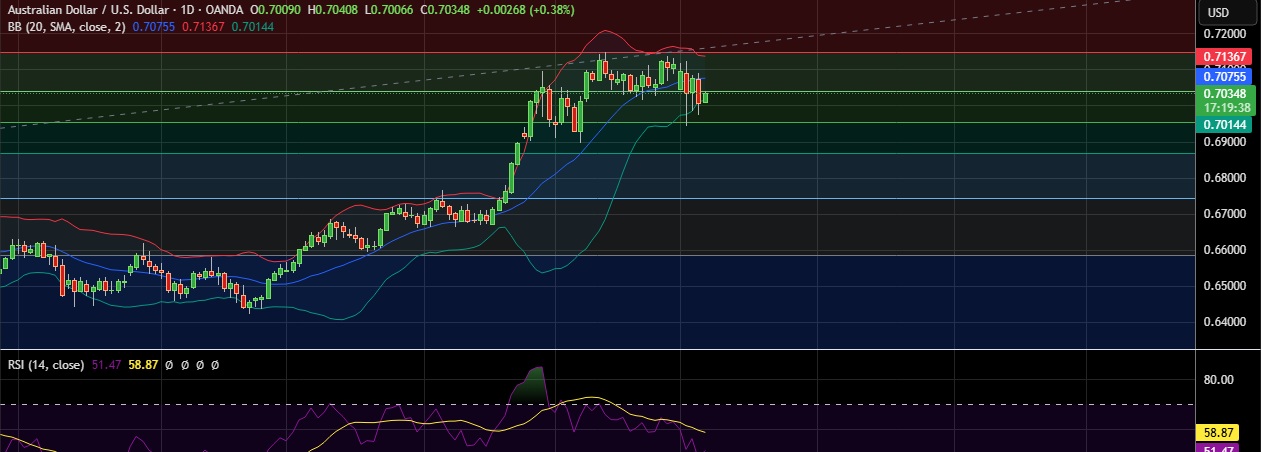
From a technical perspective, immediate resistance for the AUD/USD pair is observed at 0.7037, which aligns with the 38.2% Fibonacci retracement level. A close above this threshold could propel the pair toward the 0.7136 level, corresponding to the 20-day simple moving average. Conversely, support is noted at 0.7004, marked by the lower Bollinger Band, and a breach below this level could see the pair decline toward 0.6954, the 50% Fibonacci retracement level.
In conclusion, market dynamics suggest a favorable opportunity for traders, with a recommendation to buy around the 0.7000 mark, setting a stop loss at 0.6900 and targeting a price of 0.7100. This strategy aligns with current technical indicators and market sentiment, providing a structured approach for navigating the ongoing volatility.