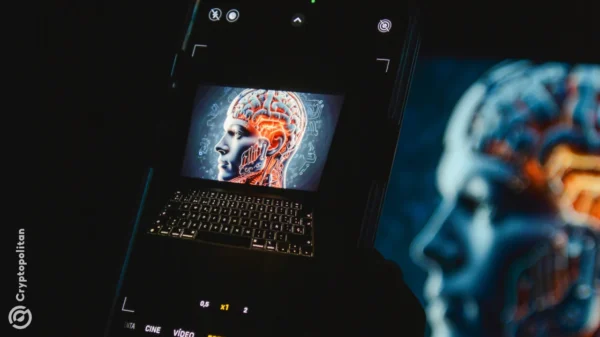












































On March 6, Ethereum co-founder Vitalik Buterin shared his vision for the future of cryptocurrency wallets by advocating for the integration of artificial intelligence (AI) alongside essential human oversight. In his post on Farcaster, Buterin highlighted the importance of not allowing AI to operate autonomously, particularly when significant financial assets are involved.
Buterin envisions a model where AI assists in formulating transaction strategies, while a local client conducts simulations before any action is taken. This approach mandates that users manually confirm high-value transactions, thereby maintaining stringent security while leveraging AI”s analytical capabilities. The aim is to strike a balance between adopting innovative solutions and ensuring user control over financial decisions.
Despite the excitement surrounding AI”s potential, skepticism persists within the developer community. Ethereum developer Andrey Petrov contributed to the discussion, suggesting that AI could simplify complex transaction details into easily understandable terms, ensuring that users are fully aware of what they are approving. He also proposed that AI could independently reconstruct transactions to verify their accuracy, flagging any anomalies for human review.
Community member fkaany took the conversation further, proposing AI”s role in designing intricate strategies, such as multi-hop swaps and yield optimization. By executing simulations beforehand, users could review and manually authorize transactions, thereby reducing their vulnerability to phishing attacks and harmful contracts.
There is currently no definitive timeline for the deployment of these advanced features, but discussions continue among developers on how to effectively incorporate AI assistance without sacrificing security. Buterin”s insights come in the wake of a report released by the Ethereum Foundation on March 1, focusing on the secure integration of AI and blockchain technologies.
The urgency of the human verification aspect has been underscored by recent events where AI systems misinterpreted data, leading to substantial financial losses. Buterin”s perspective resonates with broader concerns within the cryptocurrency community regarding the potential risks associated with unchecked AI systems.
On March 4, ConsenSys announced its investment in AI-driven security solutions, aiming to enhance wallet security and user experience. The company acknowledges the promise of AI but emphasizes the need for careful implementation. Experts in AI ethics, like Dr. Emily Chang, have expressed caution about automated financial systems lacking sufficient human oversight, warning that users could face significant risks from unauthorized or incorrect transactions.
As discussions about AI integration in the crypto space evolve, the community remains vigilant, particularly as decentralized finance (DeFi) platforms could undergo significant transformation. Dr. Alex Kim remarked on March 3 that if AI-driven analysis is executed with precision, it could notably reduce transaction errors. He emphasized the importance of keeping humans involved to catch potential oversights by AI.
In a proactive move, the Ethereum Foundation launched a grant program on March 5 to support developers focused on AI and blockchain integration, funding projects that align with Buterin”s vision of AI-assisted wallets with human checks. Notably, Chainalysis CEO Michael Gronager mentioned the exploration of partnerships with AI firms to enhance fraud detection, believing that AI could significantly improve the identification of suspicious activities within the crypto transaction landscape.
As the dialogue surrounding AI and blockchain integration progresses, the interest in utilizing AI”s capabilities while ensuring robust security measures remains strong. This conversation is particularly timely, given that wallet-related losses amounted to $2.1 billion in 2023, as reported by Chainalysis, with user errors accounting for roughly 40% of these losses.
Major wallet providers, including MetaMask and Trust Wallet, are beginning to experiment with basic AI functionalities, though none have yet implemented the advanced transaction simulations Buterin envisions. Furthermore, Coinbase revealed in February that it is in the process of developing AI-powered risk assessment tools designed to alert users about potentially hazardous smart contracts before they engage with them.
As several blockchain security firms race to create the necessary frameworks for Buterin”s proposed model, the challenge remains substantial. Current AI systems often struggle with the complex nuances of DeFi protocols, which are critical for precise transaction planning. Recently, Polygon partnered with Google Cloud to specifically train AI models on blockchain data patterns and transaction flows, aiming to bridge this gap.