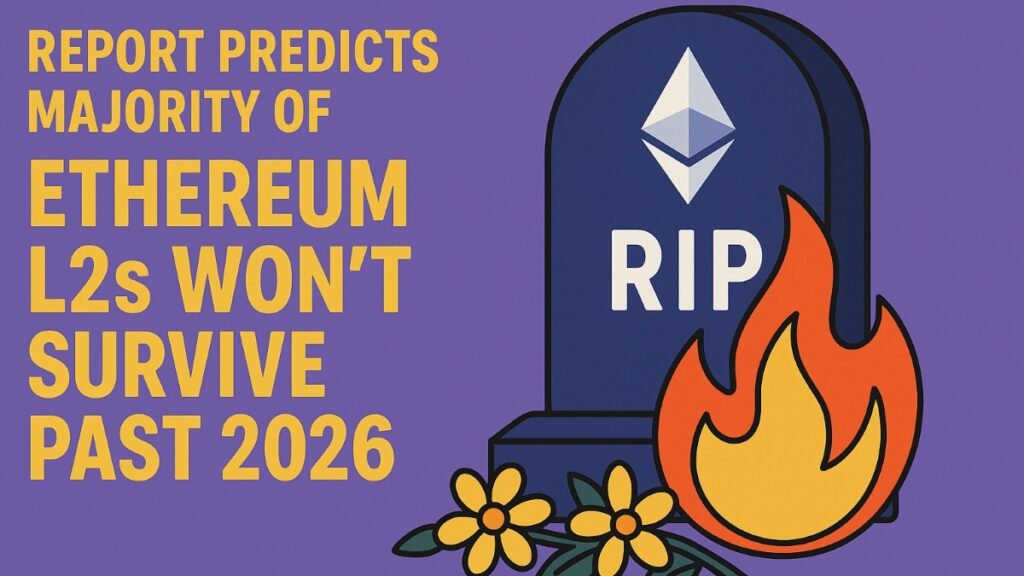
A recent report from 21Shares titled “State of Crypto” raises alarming concerns regarding the future of Ethereum”s Layer 2 (L2) solutions. According to the findings, a significant number of these networks may not endure beyond 2026 due to the increasing concentration of user activity among a select few dominant rollups.
The report highlights that nearly 90% of all L2 transactions are currently processed by just three networks: Base, Arbitrum, and Optimism. This concentration is squeezing out smaller rollups, which have experienced a staggering 61% decline in usage. As liquidity diminishes, several lesser-known projects are facing shutdowns, with some being labeled as “zombie chains” by 21Shares.
The data presents a stark picture of the current landscape. Smaller rollups have seen their relevance fade dramatically, leading to minimal activity levels. Projects such as Kinto and Loopring have ceased operations, while Blast has witnessed a catastrophic drop in total value locked by 97%. Even established decentralized finance (DeFi) protocols like Aave and Synthetix have scaled back their deployments on struggling L2s, citing insufficient liquidity and poor returns for users.
Competitive pressures intensified following Ethereum”s Dencun upgrade, which slashed data fees by approximately 90%. This has ignited fierce fee wars, placing many rollups into unprofitable scenarios. Remarkably, Base is the only L2 that reportedly achieved profitability in 2025, earning around $55 million.
Looking ahead, 21Shares anticipates a consolidation in the L2 ecosystem, focusing on three main categories of networks. These include Ethereum-aligned designs like Linea, which direct value back to the main chain, high-performance contenders such as MegaETH that aim for near real-time execution, and exchange-backed networks like Base, BNB Chain, Mantle, and Ink. The report argues that these models are best positioned to capture market activity as the stablecoin sector approaches $1 trillion in circulation and innovative financial products driven by AI reshape demand for digital assets.
In conclusion, the findings from 21Shares indicate that the Ethereum L2 ecosystem is entering a critical phase of consolidation. Many experimental rollups may ultimately be remembered as fleeting successes from an earlier period of rapid growth, highlighting the need for networks that combine strong usage with sustainable economic models.