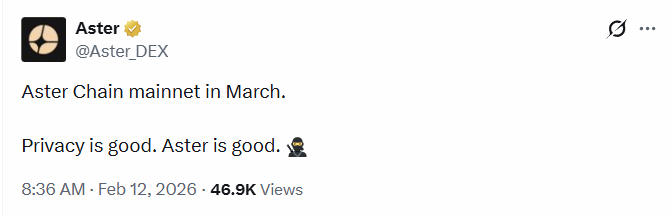
Aster Chain has officially announced a targeted launch date for its mainnet, scheduled for March 2026. This development marks a significant step for the project, which is tailored specifically for decentralized perpetual futures trading. The confirmation was shared via the project”s official X account (@Aster_DEX), providing the community with a clearer timeline for what is anticipated to be a transformative upgrade for Aster.
The new launch window refines a previously indicated timeframe of Q1 2026, which was outlined in earlier roadmaps from late 2025 and early 2026. The Layer-1 blockchain is designed with a strong emphasis on privacy, incorporating features such as zero-knowledge proofs, a “Shield Mode” for concealing trades, and rapid transaction finality with near-gasless fees. Additionally, the architecture supports on-chain order books optimized for high-frequency trading.
In conjunction with the mainnet launch, Aster plans to roll out several key features in Q1 2026, including fiat on-ramps to streamline user onboarding, an open-source release of its code, and the introduction of initial staking mechanisms for the $ASTER token. These enhancements are expected to foster further ecosystem growth.
The announcement follows a successful testnet phase, which began in early February 2026 after an initial whitelist period that started in late December 2025. During the testnet, users engaged in various trading scenarios that tested the network”s capabilities, including human-versus-AI trading sessions. Participants provided valuable feedback and identified bugs, which contributed to Aster”s readiness for the mainnet.
Why is the launch of Aster Chain significant for perpetual futures traders? The platform is built to meet the specific needs of on-chain perpetual trading, featuring privacy-centric design principles that utilize zero-knowledge proofs to enable concealed order flows. The platform”s infrastructure promises sub-second finality and execution costs that are close to zero, addressing common issues such as slippage and miner extractable value (MEV) risks.
The transition to a dedicated Layer-1 blockchain allows Aster to exercise greater control over its economic parameters, including fee structures, validator incentives, and protocol updates. This strategic shift aligns the utility of the $ASTER token more closely with the growth of the network.
Market sentiment appears to be favorable following the announcement of the mainnet launch. As of the latest data, the price of $ASTER is recorded at $0.6903, reflecting a 4.93% increase over the past 24 hours and a remarkable 26.32% rise over the past week. The token”s market capitalization stands at approximately $1.7 billion, indicating a robust performance and increased investor confidence as the launch date approaches.
The strong upward momentum in both price and community engagement suggests that traders are positioning themselves in anticipation of the upcoming upgrade. Should the development milestones continue to be met on time, the sentiment surrounding the $ASTER token could remain positive leading up to the mainnet launch.
Disclaimer: The analysis and views presented in this article serve informational purposes only and do not constitute financial advice. Market conditions remain volatile, and it is advisable for investors to conduct independent research before making financial decisions.