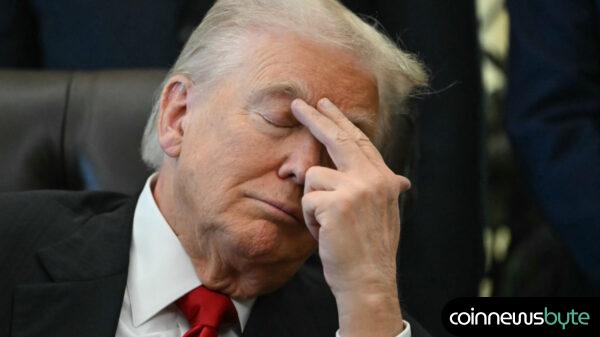
The Supreme Court of the United States (SCOTUS) has made a significant ruling, nullifying former President Donald Trump”s sweeping emergency tariffs on imported goods. This decision may lead to substantial refund requests from impacted businesses, creating ripples across various markets.
In a decisive 6-3 vote, SCOTUS determined that Trump had exceeded his authority under the International Emergency Economic Powers Act (IEEPA). This legislation, established in 1977, grants the president power to impose tariffs in response to foreign threats. However, the Court found Trump”s application of this authority to be excessive, prompting objections from small businesses and several states regarding the legality of the tariff impositions.
While the ruling did not outline how the government should handle refunding the improper tariffs, it has directed the case back to the Court of International Trade (CIT) for resolution. As a result, estimates suggest that refunds could total between $175 billion and $200 billion, based on data indicating that over $374 million has been collected from these tariffs to date.
In response to the decision, Trump”s administration has already outlined a “Plan B.” The president invoked provisions from the Trade Act to propose an additional 10% “global tariff” on items related to national security, which remain unaffected by the recent ruling. His team cited dissenting opinions from Justice Brett Kavanaugh, which suggested that the Supreme Court”s decision does not significantly limit a president”s ability to implement tariffs in the future.
Amidst this backdrop, Cantor Fitzgerald is reportedly positioned to gain significantly from the situation. Prior to the ruling, the firm began acquiring the rights to potential tariff refunds, purchasing these rights at only 20%-30% of their estimated value. This strategy means that if a firm had paid $10 million in tariffs, it could sell its refund rights for just $2 million to $3 million, allowing Cantor to collect the full government refund while reaping substantial profits.
Interestingly, although Secretary Howard Lutnick has divested his interests in Cantor, his sons, Brandon and Kyle Lutnick, may still profit from the fallout of the Supreme Court”s ruling. Analysts are forecasting that Cantor Fitzgerald could potentially secure billions from these transactions.
As the implications of the Supreme Court”s decision unfold, the cryptocurrency market is experiencing a mixed sentiment. Some within the crypto community, such as Egrag Crypto, see the ruling and Trump”s subsequent response as catalysts for uncertainty in the short term. However, there remains a broader confidence that foundational digital assets like Bitcoin (BTC), Ethereum (ETH), and XRP will maintain their structural integrity in the face of ongoing macroeconomic challenges.