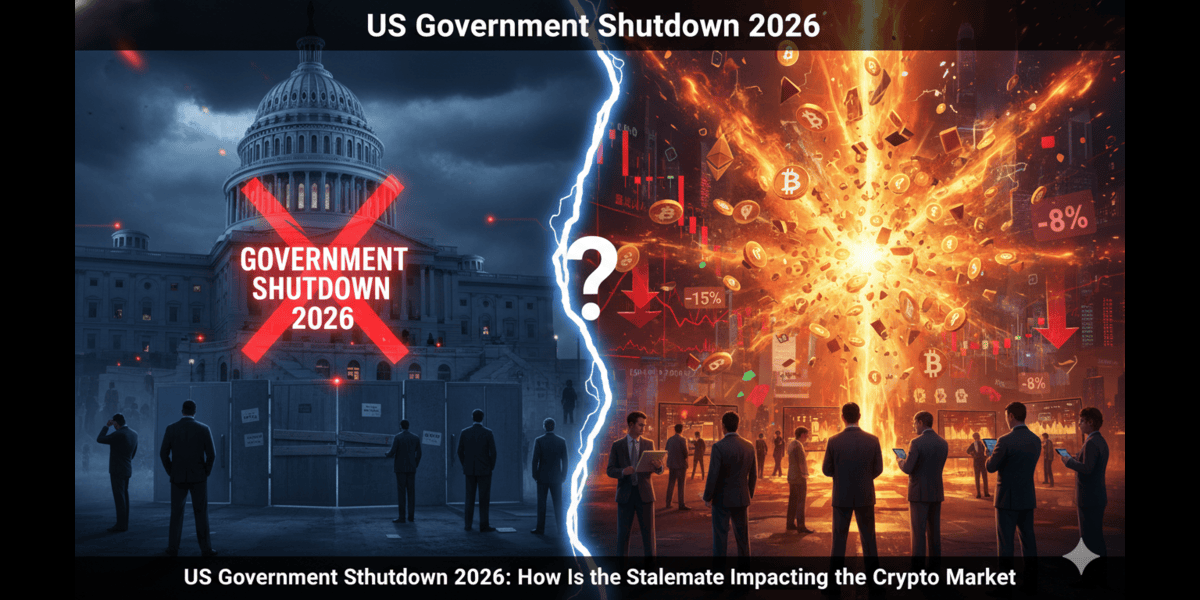
The United States has officially entered a partial government shutdown as of January 31, 2026, after the House of Representatives failed to pass a spending package approved by the Senate. This political impasse has led to immediate repercussions for the cryptocurrency sector, creating what many are calling a “data vacuum” for traders and halting essential regulatory progress at the SEC and CFTC.
As uncertainty looms, the crypto market is grappling with increased volatility, a notable surge in ETF outflows, and a standstill on significant legislative initiatives such as the CLARITY Act. The shutdown has caused market sentiment to shift into a state of “Extreme Fear,” prompting investors to withdraw capital from cryptocurrencies and redirect their funds to traditional safe havens like gold.
Impact on Bitcoin and Market Dynamics
Leading up to the shutdown, Bitcoin (BTC) experienced a downturn of approximately 7%, testing vital support levels between $81,000 and $83,000 as traders adjusted their positions. This volatility triggered massive liquidations, with over $1.68 billion wiped out from the crypto market on January 30, where long positions accounted for an overwhelming 93% of the losses.
Institutional caution is evident in the spot market, as seen by the $818 million in net outflows from spot Bitcoin ETFs in just one day. Major investors are opting to wait on the sidelines for political clarity before re-entering the market.
Regulatory Stalemate and Economic Data Delays
A prolonged shutdown is severely disrupting the operational capabilities of federal agencies, directly impacting crypto regulation and economic data releases. The SEC and CFTC have moved to “emergency-only” staffing protocols, effectively pausing the review process for at least 16 spot crypto ETF applications, including those for Solana and Litecoin. This regulatory freeze is expected to stall any new approvals or guidance until government operations resume normal functioning.
Furthermore, the Digital Asset Market Structure Bill, known as the CLARITY Act, was anticipated to make significant progress in the first quarter of 2026 but is now stalled due to the focus on resolving the budget impasse. The suspension of federal agencies means critical economic indicators, such as CPI inflation data and Non-Farm Payrolls, will also be delayed, leading to a lack of guidance for crypto traders trying to predict Federal Reserve interest rate movements.
Future Outlook Amidst Uncertainty
In the short term, the potential for further declines in Bitcoin prices exists as the market navigates this turbulent environment. Current trading conditions reflect an atmosphere of “Extreme Fear,” with Bitcoin hovering around the $81,000 mark. If the shutdown is resolved swiftly—potentially with a House vote anticipated on February 2, 2026—there may be a chance for price stabilization. However, a prolonged stalemate could challenge the narrative of Bitcoin as a “non-correlated” asset.
Historically, the perception of Bitcoin as a safe haven asset during times of governmental instability has been a topic of debate. Although some investors view it as “Digital Gold,” the current market response indicates a correlation with risk assets rather than a flight to safety. In the immediate aftermath of the shutdown, liquidity concerns are prompting investors to favor cash and physical gold over cryptocurrencies, although this sentiment could shift if the shutdown extends over a longer period.
The January 2026 government shutdown stands as a critical stress test for the evolving crypto market. With over $1.68 billion in liquidations and a halt on regulatory progress from the SEC, the situation underscores the sector”s vulnerability to U.S. fiscal challenges. Traders are advised to remain vigilant regarding the “data vacuum” and closely watch the upcoming House vote as the restoration of government operations will be crucial for bringing stability back to digital asset prices and revitalizing the industry”s legislative efforts.