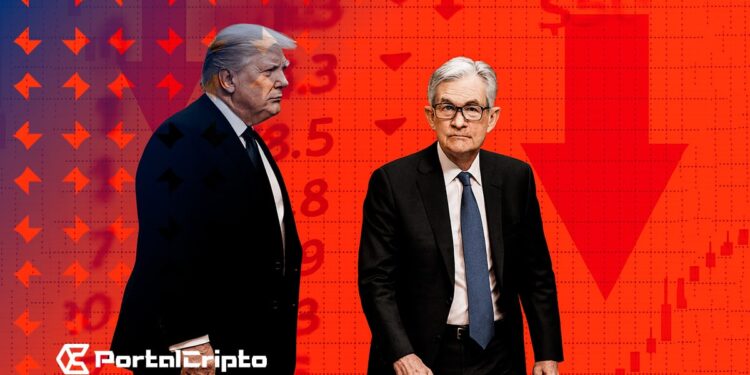
The ongoing tension between President Donald Trump and the Federal Reserve reached new heights over the weekend after the Department of Justice (DOJ) issued subpoenas to the central bank. This development has raised significant concerns regarding the independence of the Federal Reserve, particularly in light of its monetary policy decisions.
Jerome Powell, the chair of the Federal Reserve, confirmed the receipt of these subpoenas, which he suggested could expose him to criminal liability following his June testimony to Congress about potential reforms at the institution. In a statement released late Sunday, Powell denied any connection between the subpoenas and his congressional testimony, emphasizing that they should be seen as part of a broader confrontation regarding the central bank”s monetary policy conduct.
Powell remarked, “These are pretexts.” He underscored that the threat of criminal accusations stems from the Federal Reserve”s commitment to setting interest rates based on rigorous economic analysis rather than yielding to the political pressures from the President. This situation highlights the critical issue of whether the Federal Reserve can maintain its autonomy in the face of external pressures.
The immediate reaction in the financial markets was palpable. The U.S. dollar weakened against major currencies, while gold prices surged to record highs, reflecting shifts in investor sentiment amid rising institutional risk. Futures for the S&P 500 index also fell by approximately 0.3%, indicating a cautious outlook among investors.
Trump”s latest maneuver represents a marked escalation in his long-standing conflict with the Federal Reserve”s leadership. The President has vocally advocated for more aggressive interest rate cuts and has previously expressed dissatisfaction with the Fed”s approach to inflation and economic growth. Additionally, he has attempted to remove other Federal Reserve officials, a move currently under judicial review.
In light of these developments, Powell has interpreted the DOJ”s actions as part of a sustained strategy to exert influence over the Federal Reserve. He noted that any potential accusations against him should be contextualized within the broader framework of persistent threats and pressures from the current administration. Maintaining the Federal Reserve”s independence, according to Powell, is essential for ensuring that monetary policy decisions remain grounded in economic data and not swayed by political agendas.
Despite the challenging circumstances, Powell affirmed his commitment to serving in his role, stating he would continue to operate with integrity and a focus on serving the American public. He reiterated that the Federal Reserve will adhere to its legal mandate as established by Congress.