













































In a pivotal development for the cryptocurrency sector, Coinbase is positioned to reap substantial rewards from the recently enacted GENIUS Act, the United States” first comprehensive legislation governing cryptocurrencies. Signed into law in July 2025, this legislation lays down a federal framework for the issuance and regulation of stablecoins.
According to insights from Bloomberg analysts Paul Gulberg and Samuel Radowitz, the new regulatory framework has the potential to significantly bolster Coinbase”s burgeoning stablecoin operations, especially as the adoption of dollar-backed tokens like USDC continues to grow in everyday transactions.
In 2025, Coinbase”s revenue linked to stablecoins reached an estimated $1.35 billion, marking a remarkable 48% increase from $911 million in 2024. This revenue stream accounted for 19% of the company”s total annual earnings, highlighting the critical role stablecoins play in Coinbase”s overall business model.
Unlike trading fees that fluctuate with market volatility, stablecoin revenue is generated primarily from the interest accrued on reserves that support USDC. These reserves are predominantly invested in US Treasuries and other low-risk financial instruments, yielding consistent income. This arrangement allows Coinbase to benefit from a more stable and high-margin revenue source compared to transaction-based income.
The stability of this income stream became particularly evident in late 2025 when a sharp decline in the prices of Bitcoin (BTC) and other cryptocurrencies led to a 20% drop in Coinbase”s fourth-quarter earnings. In contrast, revenue from stablecoins maintained its relative stability during this downturn, which analysts believe could become even more valuable with enhanced regulatory clarity fostering broader USDC adoption.
Impact of the GENIUS Act on Stablecoin Adoption
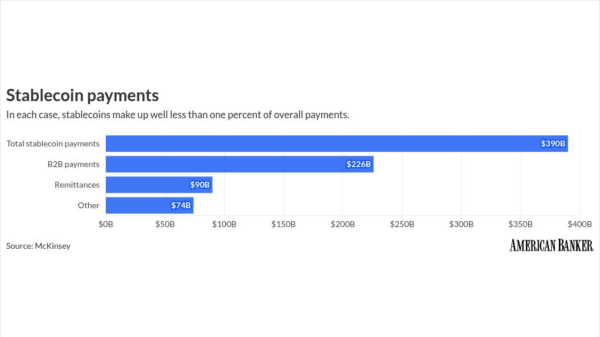
The GENIUS Act is expected to be pivotal in accelerating the growth of USDC. By establishing a national regulatory framework for stablecoin issuers, the legislation aims to dismantle existing barriers limiting the use of USDC in various applications, including cross-border payments and merchant transactions.
A broader acceptance of stablecoins among businesses and financial institutions for real-world applications could lead to a substantial increase in the supply of USDC. Such an expansion would necessitate additional reserves to back the newly issued tokens, resulting in increased interest income from the underlying Treasury investments. Coinbase, sharing in this yield, stands to benefit directly from greater adoption.
Bloomberg analysts project that under favorable conditions, Coinbase”s revenue associated with USDC could experience growth ranging from two to seven times its current level. However, achieving the upper end of this projection is contingent on Coinbase”s ability to continue providing incentives for customers holding USDC. Analysts suggest that if customer reward programs persist, the adoption of USDC could accelerate significantly.
Even if these reward initiatives are curtailed in ongoing discussions surrounding the CLARITY Act, the favorable regulatory landscape established by the GENIUS Act is still anticipated to promote meaningful growth in stablecoin utilization.
At the time of this report, Coinbase”s stock, trading under the ticker symbol COIN, was on an upward trajectory, approaching $185 during Wednesday”s trading session, reflecting a 22% increase within a 24-hour period.
With the GENIUS Act paving the way for a more robust stablecoin market, Coinbase is set to play a crucial role in shaping the future of cryptocurrency transactions.