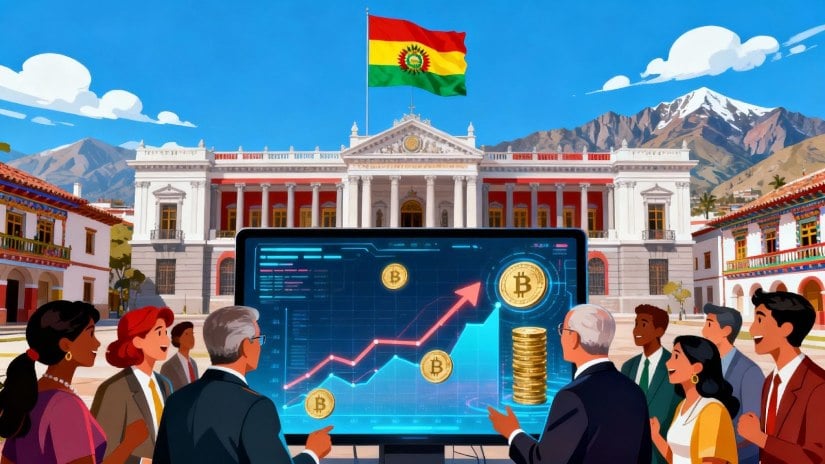
On November 26, 2025, Bolivia”s Economy Minister Jose Gabriel Espinoza announced a historic policy change allowing the integration of cryptocurrencies and stablecoins into the country”s banking system. This shift comes just 18 months after Bolivia lifted a long-standing ban on digital assets, representing a significant reversal in cryptocurrency policy within Latin America.
Under the new framework, banks are now authorized to hold cryptocurrencies on behalf of clients and offer a range of digital currency-based financial products, including savings accounts, credit cards, and loans. Espinoza stated, “You can”t control crypto globally, so you have to recognize it and use it to your advantage,” emphasizing the need for adaptation in a rapidly evolving financial landscape.
Bolivia”s journey into the world of cryptocurrency has been transformative. The country maintained stringent restrictions for nearly a decade, which were lifted in June 2024 when the Central Bank of Bolivia (BCB) issued Board Resolution N°082/2024. This resolution allowed cryptocurrency transactions via authorized electronic channels, spurred by economic pressures and the influence of neighboring countries adopting similar regulations.
Since the ban”s repeal, Bolivia has seen remarkable growth in crypto adoption, with Chainalysis data indicating approximately $14.8 billion in stablecoin and cryptocurrency transaction volume between July 2024 and June 2025. This surge placed Bolivia 46th globally in terms of crypto adoption, with transaction volumes increasing over 630%, from $46.5 million in the first half of 2024 to $294 million in the first half of 2025.
The economic crisis, characterized by soaring inflation rates exceeding 22% over the past year and acute shortages of US dollars, has significantly influenced this digital currency adoption. Businesses and individuals are increasingly turning to digital alternatives to safeguard their purchasing power. Major automotive manufacturers in Bolivia, such as Toyota and Yamaha, began accepting USDT payments for products in September 2025, highlighting the demand for dollar-equivalent assets that circumvent traditional banking systems.
Furthermore, Bolivia”s state-owned energy company, Yacimientos Petrolíferos Fiscales Bolivianos (YPFB), has taken a pioneering role in government cryptocurrency adoption. In March 2025, YPFB revealed plans to utilize cryptocurrencies for energy imports amid significant dollar shortages, marking a pivotal moment in the government”s embrace of digital assets for economic stability.
In response to this evolving landscape, Bolivia”s banking sector has swiftly adapted. Banco Bisa introduced a stablecoin custody service in October 2024, primarily focused on Tether”s USDT. This move illustrates a significant shift for Bolivia”s financial institutions, which previously operated under strict prohibitions against cryptocurrency services.
As part of its modernization efforts, the Bolivian government is actively collaborating with international entities to develop a robust regulatory framework for digital assets. In July 2025, the BCB signed a memorandum with El Salvador”s National Commission of Digital Assets to share best practices for creating a transparent digital ecosystem. This partnership aims to enhance regulatory frameworks and risk analysis models while fostering financial literacy among citizens.
Bolivia”s rapid transition from cryptocurrency prohibition to full integration underscores how economic challenges can catalyze financial innovation. By embracing digital currencies, Bolivia positions itself as a potential leader in the adoption of practical digital asset solutions, addressing both currency instability and international trade facilitation.