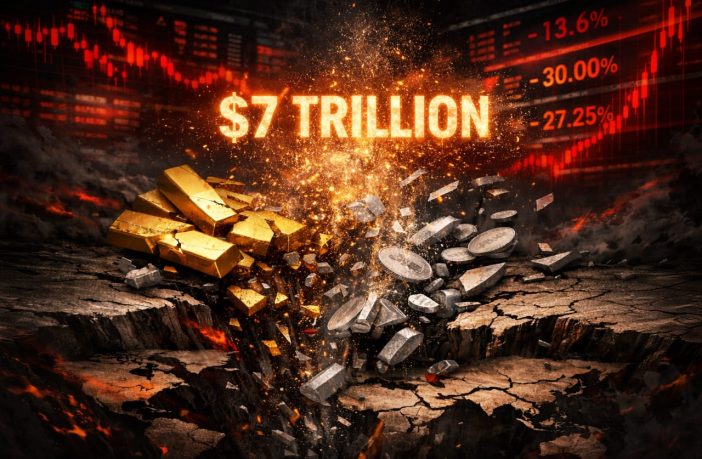
The global precious metals markets have plunged into one of the most severe sell-offs in recent financial history, with over $7 trillion in market value evaporating in a mere 36 hours. What initially began as profit-taking rapidly escalated into a widespread market rout, causing gold, silver, platinum, and palladium to experience sharp declines. Investors who flocked to these metals as safe havens now find themselves scrambling to exit as prices plummet at an unprecedented pace.
Gold has been at the forefront of this collapse, witnessing its largest single-day decline ever recorded. Spot gold, which recently peaked at $5,600, has plummeted to around $4,682 per ounce within a span of 24 to 48 hours. This staggering drop has wiped out nearly $5 trillion in market capitalization, sending shockwaves through trading floors worldwide. Analysts attribute this drastic shift to a sudden change in risk appetite, compounded by aggressive profit-taking following months of significant gains.
Market sentiment has flipped alarmingly fast, with bullish momentum dissipating almost overnight. Once perceived as a breakout, the situation has devolved into a brutal correction.
Silver, on the other hand, has showcased some of the most extreme price volatility traders have ever encountered. During intraday trading, silver experienced a dramatic drop of up to 35%, marking its largest intraday decline in history. Prices briefly fell below $70 per ounce, erasing approximately $1.96 trillion in market value. Despite this turmoil, silver managed to close the month in the green, up 19%, extending its remarkable rally to nine consecutive months of gains.
The turbulence does not end with gold and silver; platinum has seen prices collapse by 27.25%, dropping below $2,100 per ounce and erasing roughly $215 billion in value. Palladium followed suit, plunging by 21.5% to fall under $1,700 per ounce, resulting in an additional loss of about $85 billion. Both metals had previously attracted significant speculative inflows as investors anticipated industrial demand and supply shortages. However, as risk sentiment shifted in broader markets, traders liquidated positions across the precious metals spectrum.
This synchronized liquidation event has been fueled by margin calls, algorithmic trading, and a pervasive sense of fear, causing selling to accelerate beyond typical correction levels. Once negative momentum sets in, bids rapidly disappear, exacerbating the decline.
A pivotal moment contributing to the crash was the announcement that Kevin Warsh, seen as pro-Bitcoin and favorable for the markets, would be the new Federal Reserve Chair. This news spurred a substantial shift in investor positioning, with markets interpreting it as a potential pivot toward more relaxed monetary policies. Consequently, capital began flowing out of precious metals and into riskier assets, including cryptocurrencies and equities. The combination of heavy selling pressure and thin liquidity created an ideal environment for a sharp correction.
When all is said and done, the total losses are staggering: gold has dropped 13.6%, wiping out $5 trillion; silver is down 30%, erasing $1.96 trillion; platinum has fallen 27.25%, losing $215 billion; and palladium is down 21.5%, shedding $85 billion. This total of over $7 trillion marks one of the largest wealth destructions in commodity history.
Veteran traders are drawing parallels between this event and major financial crashes of the past, highlighting how quickly leverage can unwind when confidence falters. The rapidity of the decline underscores the influence of modern trading systems, characterized by high-frequency trading and significant institutional flows.
Despite the unprecedented losses, analysts advise against panic selling. Historically, such massive liquidation events can signal turning points rather than indicate long-term declines. Strong fundamentals, including inflation hedging, central bank demand, and industrial applications, continue to support precious metals over the long haul. The fact that silver closed the month positively despite the crash suggests underlying strength.
Nevertheless, investors should brace for continued volatility in the near term as markets respond not only to economic indicators but also to political shifts, changes in sentiment, and algorithm-driven trading at an unprecedented pace. The critical takeaway for investors is clear: the perception of precious metals as stable, slow-moving safe havens has shifted; they now exhibit the volatility characteristic of high-risk assets.