




































Financial markets were shaken on Tuesday as escalating tensions in the Middle East influenced trading dynamics across various assets, including cryptocurrencies. The ongoing conflict involving Iran, Israel, and the United States caused oil prices to surge, while stock indices saw notable declines. This geopolitical volatility set the stage for a risk-off sentiment, impacting not just traditional markets but also the cryptocurrency sector.
The primary catalyst for the market”s negative trajectory was the deterioration of relations between Israel and Iran, compounded by reports of Iranian strikes that heightened fears of wider conflict. In particular, the closing of the Strait of Hormuz, a critical maritime route for oil shipments, fueled market anxiety. This situation was somewhat alleviated after President Trump announced the provision of political risk insurance for maritime trade and indicated that the US Navy would escort tankers through the Strait.
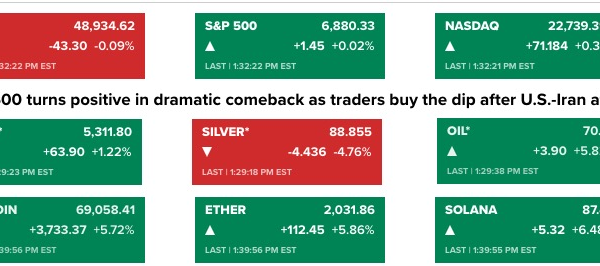
In terms of market performance, US equities closed significantly lower, with the Dow Jones Industrial Average dropping 0.83%, the S&P 500 losing 0.94%, and the Nasdaq Composite falling by 1.02%. The Russell 2000, which represents small-cap stocks, experienced a sharper decline of 1.79%. Contrastingly, crude oil prices surged nearly 5.5% to reach $75.08 per barrel amidst the heightened tensions.
On the commodities front, gold faced a steep drop, declining by 4.45% to fall below the $5,100 per ounce mark, marking its most significant decline since early February. Meanwhile, Bitcoin mirrored the broader market risk aversion, decreasing by $834 or 1.21% to a price of $68,000. This trend reflects a consistent pattern in which cryptocurrencies react to macroeconomic and geopolitical developments.
As Federal Reserve officials provided insights into the economic outlook, the tone remained cautious amid the geopolitical backdrop. Neel Kashkari, the President of the Minneapolis Fed, acknowledged the potential implications of the Iran conflict on inflation and monetary policy, emphasizing that energy price spikes could influence future decisions. Meanwhile, John Williams, the New York Fed President, reassured that long-term inflation expectations remained stable, indicating that the Fed”s current policy stance is adequately positioned.
Looking ahead, traders are bracing for further developments in the Gulf region. With critical economic data on the horizon, including Australian GDP figures, Chinese PMIs, and the US ISM Services PMI, market participants will be assessing whether the domestic economy can withstand the pressures of rising energy prices and global instability.
As the situation unfolds, the intertwining of geopolitical events and financial markets underscores the need for vigilance among investors, particularly in the cryptocurrency space, where volatility can be pronounced.