












































This week, significant announcements from major players in the stablecoin sector, including Tether, Circle, and Revolut, highlight the growing interest in this digital asset class. However, recent findings from McKinsey reveal that despite this expansion, stablecoins still represent a negligible portion of the overall payments landscape.
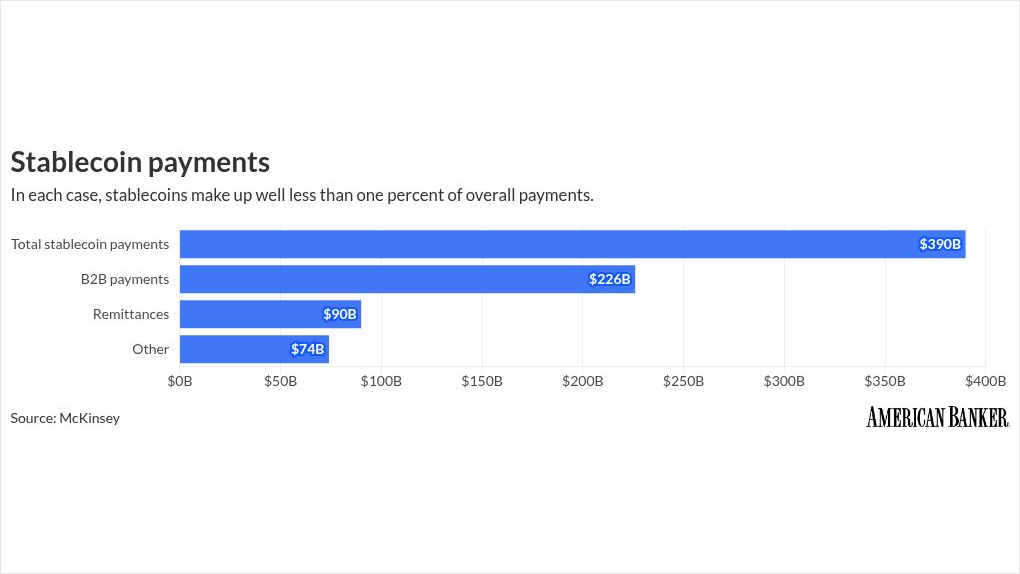
The stablecoin market has seen tremendous growth, with approximately $300 billion now in circulation, a notable increase from less than $30 billion in 2020. Projections indicate that the supply could soar to between $3 trillion to $4 trillion by 2030. Nevertheless, McKinsey emphasizes that actual stablecoin payments remain minimal, amounting to only about $390 billion by 2025, which constitutes a mere 0.02% of global payment volumes.
In the context of B2B payments, stablecoins are projected to account for around $226 billion in 2026, translating to just 0.01% of the total global B2B payment volume, estimated at $1.6 quadrillion. For remittances, stablecoin usage is even less significant, with anticipated volumes of approximately $90 billion, representing less than 1% of the over $100 trillion total for remittance transactions.
Despite these figures, the potential benefits of stablecoins are acknowledged, particularly in improving cross-border payment efficiencies. Furthermore, interest from financial institutions is on the rise; a recent survey revealed that 47% of banks reported clients seeking information about cryptocurrency, while 35% indicated a demand for cryptocurrency payment capabilities.
Tether is actively positioning itself to capitalize on this growth, recently investing in Whop, an internet marketplace aimed at enhancing the use of its USDT and USAT stablecoins for international payments. CEO Paolo Ardoino stated, “Stablecoins and wallets become most powerful when they are embedded directly into people”s lives.” This investment will support expansion efforts in regions such as Latin America and Asia-Pacific.
Circle is also witnessing positive momentum, reporting $75.3 billion of USDC in circulation by the end of 2025, marking a 72% increase year-over-year. However, the company did incur a net loss of $70 million primarily due to stock-based compensation related to its initial public offering.
Meanwhile, Revolut has been selected by the U.K. Financial Conduct Authority to participate in a stablecoin sandbox for testing stablecoin technology under reduced regulatory pressure. This initiative aims to explore stablecoin applications in payments and trading as new regulations approach.
In other developments, Visa has made strides in Argentina through the acquisition of Prisma and Newpay, enhancing its capabilities in real-time payments and local transaction management.
As the stablecoin market continues to evolve, it”s clear that while growth is evident, substantial integration into the mainstream payments infrastructure remains a challenge. The upcoming years will be pivotal in determining the role stablecoins will play in the global financial ecosystem.