


























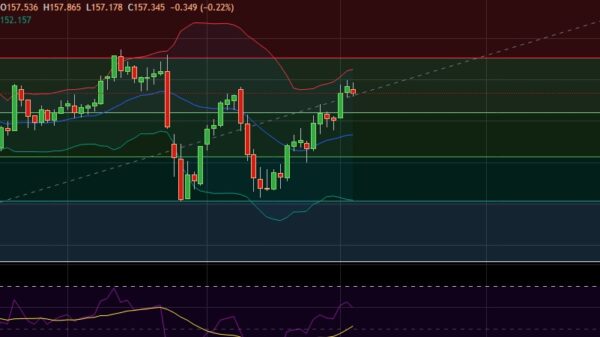

















Synopsys Inc. experienced a notable surge of approximately 8% in premarket trading on December 1, 2025, following the announcement of a substantial $2 billion equity investment from Nvidia Corp.. In early trading, shares of Synopsys reached $449.94, marking a significant increase of $31.93 or 7.64% from the previous closing price of $418.01.
This remarkable movement comes as both tech giants unveiled an enhanced strategic partnership designed to transform engineering and design across various sectors via advancements in artificial intelligence and accelerated computing.
Nvidia acquired Synopsys shares at $414.79 each, a price slightly below the closing figure of $418.01 on Friday, which indicates a strong endorsement of the chip-design software firm. This investment arrives at a time when Synopsys stock had fallen nearly 14% year-to-date by the end of last week, suggesting Nvidia saw a lucrative entry point.
The collaboration will see the integration of Nvidia”s CUDA accelerated computing platform with Synopsys” leading engineering solutions, which encompass chip design, physical verification, molecular simulations, and electromagnetic analysis. This partnership is particularly focused on enhancing agentic AI workflows, developing digital twins through Nvidia”s Omniverse, and creating cloud-ready engineering solutions.
Both companies have clarified that this partnership remains non-exclusive, enabling continued relationships throughout the broader semiconductor and electronic design automation (EDA) ecosystem.
Despite recent underperformance, Synopsys maintains a dominant position in the EDA market, with a market capitalization of $77.65 billion as of November 28. The company operates with a trailing price-to-earnings (P/E) ratio of 56.49 and a forward P/E of 28.25, with analysts averaging a price target of $551.04. Year-to-date, Synopsys has lagged behind the broader tech sector, down 13.88%, compared to the S&P 500″s gain of 16.45%, although it has achieved a 27.01% return over the past three years.
The Nvidia investment has raised questions concerning potential circular deals that might artificially inflate valuations, as companies receiving Nvidia”s backing could subsequently increase their purchases of Nvidia chips. Nevertheless, the strategic rationale appears valid, especially given the increasing complexity of developing AI-driven intelligent systems. This evolution necessitates a deeper integration of electronics and physics, accelerated by cutting-edge computing capabilities.
Through this collaboration, both companies are well-positioned to tackle engineering challenges across sectors such as semiconductor, aerospace, automotive, and industrial, potentially unlocking new market opportunities via GPU-accelerated simulations at unprecedented speeds and scales.
It is crucial for investors to remain informed on such developments, as these partnerships could reshape the landscape within the technology sector.