












































In a significant shift in investment strategy, major financial institutions such as Bank of America, Morgan Stanley, and Fidelity Investments are now recommending that investors allocate a small percentage of their portfolios to Bitcoin. These firms suggest that a range of 1% to 5% is appropriate for diversifying portfolios with Bitcoin.
According to recent reports, the perception of Bitcoin is evolving among these institutions, which now regard it as a valuable diversifier rather than merely a speculative asset. A report by River indicates that several large institutions have formalized their guidance on crypto exposure, emphasizing limited risk while still permitting participation in potential price gains.
Fidelity Investments encourages clients to commit between 2% and 5% of their portfolios to crypto assets, including Bitcoin. Meanwhile, Bank of America suggests an allocation of 1% to 4%, and Morgan Stanley recommends a maximum exposure of 4%. In contrast, BlackRock has set a narrower range of 1% to 2% for Bitcoin holdings, aligning with a conservative investment approach. Other firms like WisdomTree and JPMorgan Chase propose even lower allocations, capped at 1%.
This guidance reflects a structured approach to asset management, as these firms are increasingly incorporating Bitcoin into their alternative asset frameworks for private clients. By establishing clear allocation ranges, these institutions aim to balance the inherent volatility of Bitcoin with the need for portfolio stability.
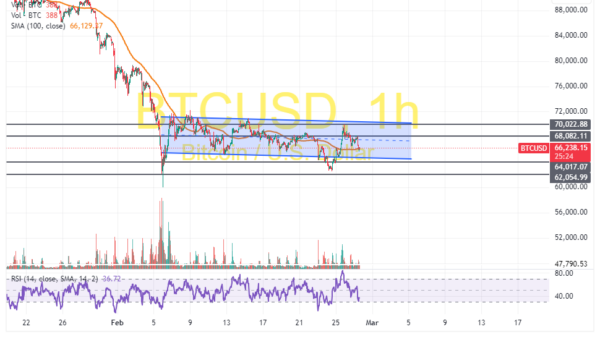
Despite recent challenges in the market, including a notable price decline from an October peak of $126,080 to $67,441—representing a 47% drop—analysts from institutions like JPMorgan remain optimistic about Bitcoin”s long-term potential. They project it could reach $266,000, contingent upon its ability to rival gold as a preferred store of value.
Additionally, BlackRock“s CEO, Larry Fink, has made bold predictions, suggesting Bitcoin could soar to $700,000 per coin, driven by concerns surrounding currency devaluation and global economic instability. Such projections highlight the ongoing interest and belief in Bitcoin”s capacity to serve as a hedge against financial uncertainties.
As these major Wall Street firms continue to adapt their strategies regarding Bitcoin, the cryptocurrency”s role in diversified investment portfolios appears to be solidifying, offering a blend of risk management and potential for substantial returns.