













































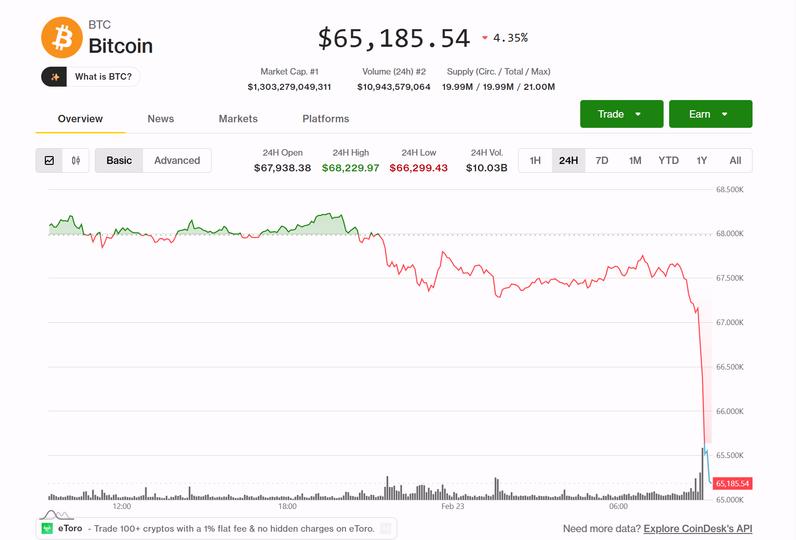
Bitcoin has experienced a decline of 4.4%, settling at approximately $65,000 as the trading week begins in Asia. This downturn follows a notable drop from the $67,000 range where it was positioned over the weekend. According to on-chain data from Glassnode and CryptoQuant, while the immediate panic may be subsiding, the overall market structure continues to face pressure.
Recent metrics from Glassnode indicate that newer Bitcoin investors have been realizing substantial losses. On February 6, a smoothed 7-day measure revealed that short-term holders were collectively locking in losses exceeding $1.24 billion per day. As of today, this figure has moderated to around –$0.48 billion per day, suggesting that although the pace of panic selling has eased, it has not completely halted.
Data from CryptoQuant supports this view, illustrating a shift in market dynamics. The report highlights that the volume of Bitcoin flowing to exchanges surged to nearly 60,000 BTC per day during the early February price drop towards $60,000. This figure has since decreased to approximately 23,000 BTC on a 7-day smoothed basis, indicating a cooling of the immediate selling pressure. However, the profile of the sellers has changed significantly.
CryptoQuant”s “exchange whale ratio” has risen to 0.64, representing the highest level observed since 2015. This statistic implies that nearly two-thirds of the Bitcoin entering exchanges derives from just the ten largest deposits each day. In essence, larger holders, commonly referred to as whales, are now responsible for the majority of the supply hitting exchanges, as reflected in the increased average size of each deposit, which has reached levels not seen since mid-2022. This trend underscores that it is predominantly larger players, rather than retail investors, who are currently influencing the exchange activity.
In the altcoin arena, a broader distribution is apparent. CryptoQuant”s findings indicate that average daily altcoin exchange deposits have risen to about 49,000 in 2026, a notable increase from the approximately 40,000 recorded in the fourth quarter of 2025. Historically, elevated deposit activity for alternative tokens has been associated with heightened volatility and a diminished risk appetite among investors.
Additionally, liquidity buffers are experiencing a contraction. Net USDT inflows to exchanges have plummeted from a one-year peak of $616 million in November to just $27 million recently, with a brief period of negative inflows noted in late January. Typically, stablecoin inflows increase during bullish market phases; their current decline suggests a reduction in marginal buying power.
In summary, the combination of loss-realization metrics from Glassnode and exchange activity data from CryptoQuant paints a picture of a market that is processing a capitulation event but has yet to see a robust revival in demand. As the week unfolds, the critical question remains whether the $65,000 price level will serve as a reliable pivot point or if Bitcoin will continue to navigate a prolonged base-building phase.