





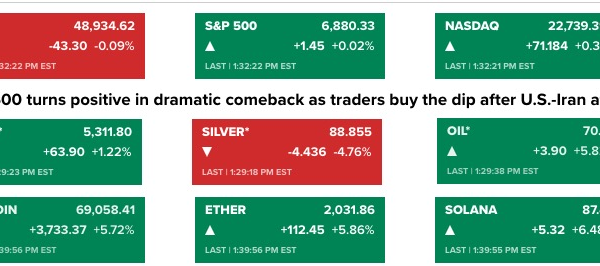





































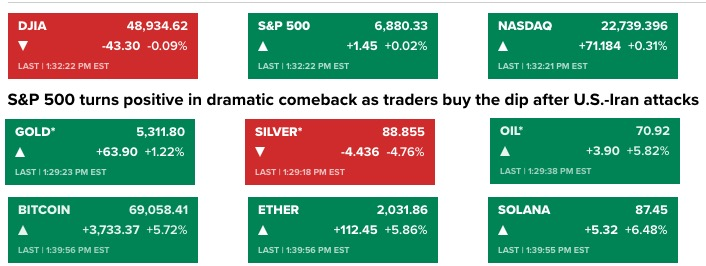
Bitcoin is nearing the significant threshold of $70,000 as escalating military tensions between the United States and Iran contribute to notable volatility across various asset classes. Following a sharp decline to $63,255 on February 28 due to risk-off sentiment, BTC staged a remarkable V-shaped recovery, climbing back above $69,000 as demand from institutional exchange-traded funds (ETFs) surged.
In parallel, gold prices have soared to unprecedented levels exceeding $5,377, while Brent crude oil approached $80 amid concerns related to the Strait of Hormuz. With the Federal Reserve maintaining interest rates between 3.50 and 3.75 percent, inflationary pressures are becoming a significant consideration, placing Bitcoin at a pivotal macroeconomic juncture close to the $70,000 mark.
The current trading environment for Bitcoin reflects a complex interplay of factors. After a significant drop, the cryptocurrency rebounded sharply, aided by renewed interest in spot Bitcoin ETFs coinciding with the reopening of US exchanges and CME futures. This resurgence in demand has propelled Bitcoin just below the psychological barrier of $70,000.
During this tumultuous period, US equities have also shown resilience, bouncing back with a V-shaped recovery primarily led by defense and energy sectors despite oil prices fluctuating between $72 and $79. Notably, Bitcoin has seen its dominance rise to approximately 56 to 57 percent, indicating a concentration of capital flowing into BTC rather than dispersing across altcoins.
The correlation between Bitcoin and US equities remains moderate, hovering around 0.55. This suggests a degree of detachment, although BTC is still partially influenced by stock market movements. The rebound structure indicates a shift towards viewing Bitcoin as a geopolitical hedge, rather than merely a speculative asset.
Short positioning has also played a crucial role in this dynamic. As Bitcoin reclaimed key levels, many leveraged short positions were liquidated, further enhancing the upward momentum. Currently, the market is at a technical crossroads, with liquidity significantly compressed beneath the $70,000 level. A breakout or a pullback from this point is likely to dictate the near-term trend.
Key drivers of market movement continue to be the headlines surrounding US–Iran relations, the backdrop of the Federal Reserve”s policies, and ongoing inflation concerns. The geopolitical escalations remain a primary macroeconomic influence, as initial reactions to military actions led to a widespread selloff in risk assets. However, Bitcoin quickly reversed its trajectory as the narrative shifted towards its role as a decentralized hedge.
Looking at the broader economic landscape, the Federal Reserve”s decision to maintain interest rates post-January meeting is noteworthy. Inflation indicators, such as the January Producer Price Index (PPI) rising to 2.9 percent, suggest persistent price pressures. Additionally, Brent crude”s price surge towards $77 to $82 raises concerns around stagflation, potentially delaying any anticipated rate cuts and tightening liquidity conditions.
From a long-term perspective, industry expert Arthur Hayes emphasizes that prolonged military engagements often lead to fiscal expansion and subsequent monetary easing. This historical context may suggest that Bitcoin could achieve significantly higher valuations over time, reinforcing its narrative as a hedge against fiat currency debasement.
In the short term, however, the market faces competing forces. Higher interest yields and a strengthening dollar could pressure the crypto market, while expanding fiscal deficits and potential monetary easing bolster Bitcoin“s macroeconomic arguments.
In terms of ETF activity, US spot Bitcoin ETFs have recently rebounded after experiencing five consecutive weeks of outflows. In just three trading sessions, these funds attracted over $1 billion in net inflows, with IBIT standing out by recording a $297 million inflow on February 25. Other funds display varied trends, with GBTC seeing rare positive sessions amidst a longer history of outflows, while both FBTC and ARKB reflect mixed institutional interest.
As for market sentiment, it currently stands at elevated levels of greed, around 75 out of 100, which historically near major resistance levels often precedes shakeouts intended to clear leveraged positions before sustained trends can develop. Over the next 24 to 72 hours, market direction will be influenced heavily by ETF flows, the strength of the dollar, bond yields, and any further geopolitical developments.
Bitcoin remains at a delicate balance between breakout potential and volatility driven by macroeconomic factors, with institutional flows and headline risks acting as the primary catalysts for future movements.