













































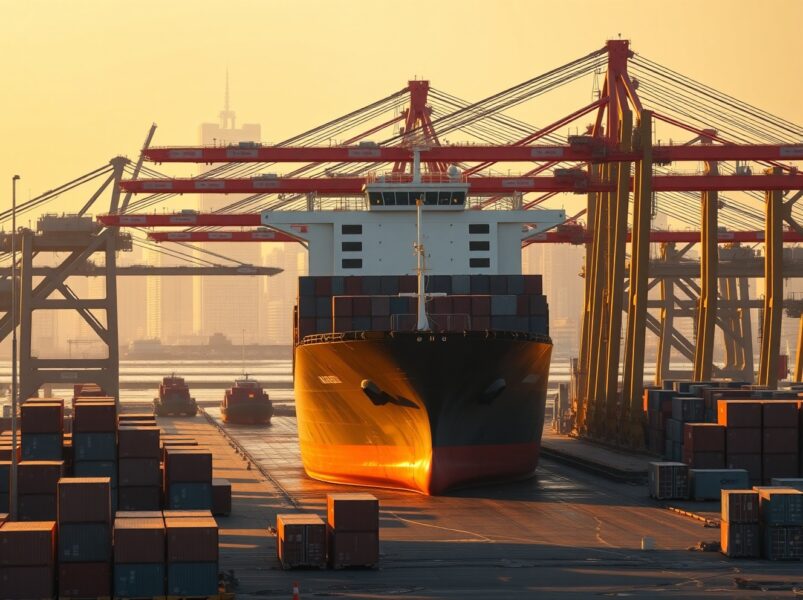
In 2025, China”s export sector is showcasing remarkable resilience, which is proving essential for the Chinese yuan (CNY) amid a landscape of global economic uncertainties. Recent insights from Commerzbank indicate that ongoing trade surpluses are fundamentally reinforcing the currency”s value. This dynamic between export performance and currency strength is a crucial aspect of international finance, as emphasized by Frankfurt-based economists.
The relationship between China”s trade balance and yuan valuation unfolds through several interconnected channels. Consistent export revenues bolster the foreign exchange reserves of the People”s Bank of China (PBOC), granting the central bank substantial capacity for market interventions during periods of volatility. Additionally, robust export performance signifies a healthy economy, making Chinese assets more appealing to foreign investors, thus driving demand for the yuan. Furthermore, these export earnings contribute significantly to China”s current account surplus, a key factor in determining currency strength under balance of payments theory.
Data from China”s General Administration of Customs highlights persistent trade surpluses early in 2025, with January exports reaching $315.7 billion against imports of $227.4 billion, resulting in an $88.3 billion monthly surplus that directly supports the yuan”s valuation. Over the past twelve months, the cumulative surplus has surpassed $900 billion, underscoring the export sector”s pivotal role despite evolving global supply chains.
Commerzbank economists Ulrich Leuchtmann and Hao Zhou have conducted an in-depth analysis of China”s export-currency connection, identifying three primary factors that sustain the country”s export competitiveness. First, China benefits from manufacturing scale advantages that are difficult for competitors to replicate. Second, the nation has successfully transitioned its export mix towards higher-value products. Lastly, regional trade agreements have expanded China”s export destinations beyond traditional Western markets.
The composition of China”s exports has evolved significantly, with high-tech exports now accounting for 32% of total exports, as per 2024 data. This includes sectors such as electric vehicles and renewable energy equipment, which contribute disproportionately to trade surpluses and enhance the country”s terms of trade, further supporting the yuan”s valuation.
The PBOC employs a managed floating exchange rate system, referencing a currency basket. This approach is influenced by export performance through various mechanisms. Strong export figures reduce the pressure for competitive devaluation, as the trade sector demands less currency support. Additionally, higher export earnings enhance foreign exchange reserves, granting the PBOC greater flexibility to manage policies effectively. Recent interventions by the PBOC illustrate this connection; during times of strong exports, the central bank has permitted greater appreciation of the yuan against the dollar, while providing more substantial support during periods of temporary export weakness.
China”s export resilience is set against a backdrop of complex global conditions. Geopolitical tensions are still affecting trade patterns, with some Western economies imposing targeted restrictions. However, rising demand from emerging markets has partially offset the decline in orders from traditional partners, with Southeast Asian nations now representing 18% of China”s exports, a significant increase from 12% five years prior. This geographical diversification helps mitigate vulnerability to economic fluctuations in any single market.
Amidst global inflationary pressures, Chinese exporters are navigating both challenges and opportunities. Although input costs have risen, China”s manufacturing efficiency allows it to maintain price competitiveness. The country”s producer price index saw a modest increase of 1.2% year-over-year in January 2025, contrasting sharply with the 3.4% rise in the European Union. This stability in prices supports export volumes even amidst broader economic headwinds, while effective currency management helps alleviate imported inflation, fostering a positive cycle for trade competitiveness.
Comparative analysis from the World Trade Organization highlights China”s export performance relative to other major economies. In 2024, China”s export growth was at +5.7%, with a projection of +4.9% for the first quarter of 2025, markedly outperforming countries such as Germany, the United States, Japan, and South Korea. This consistent performance directly bolsters currency valuation through improved terms of trade, increased portfolio investment, and reduced reliance on capital controls, paving the way for more market-driven exchange rates.
Several structural factors underpin China”s sustained export strength amid global challenges. The nation”s manufacturing ecosystem is robust and vertically integrated, minimizing exposure to external supply disruptions. Furthermore, significant investments in logistics have led to high port efficiencies, as noted by World Bank metrics. The digital transformation of Chinese exporters through e-commerce and digital trade initiatives also enhances market access and reduces transaction costs, supporting small and medium enterprises significantly.
Looking ahead, Commerzbank”s analysis identifies both supportive trends and potential risks for the export-currency relationship. Positive factors include technology upgrades that enhance export margins, increased regional integration through the RCEP agreement, and rising global demand for renewable energy equipment. Nonetheless, risks such as geopolitical tensions, demographic shifts leading to higher labor costs, and environmental compliance costs require close observation. Despite these challenges, current indicators suggest that China”s exports will continue to underpin the CNY throughout 2025.
In summary, China”s export sector is integral to the strength of the CNY, operating through multiple interrelated channels. Commerzbank”s insights illustrate how trade surpluses amplify foreign exchange reserves, indicate economic robustness, and attract investment flows. This relationship remains vital even as global trade patterns evolve and economic challenges persist, emphasizing the importance of understanding the export-currency nexus for insights into China”s economic trajectory and its global market implications.
FAQs
Q1: How exactly do exports support a currency”s value?
A1: Exports generate foreign currency earnings, increasing demand for the domestic currency during conversion, which exerts upward pressure on the exchange rate.
Q2: What makes China”s export sector particularly resilient?
A2: China benefits from manufacturing scale, comprehensive supply chains, technological advancements, and geographical diversification, moving into higher-value exports while remaining competitive in traditional sectors.
Q3: How does the People”s Bank of China manage the yuan exchange rate?
A3: The PBOC utilizes a managed floating system, referencing a currency basket and setting daily reference rates, intervening as necessary based on export performance and foreign exchange reserves.
Q4: Are there risks to China”s export-dependent currency support?
A4: Potential risks include geopolitical tensions affecting trade, rising labor costs, compliance costs from environmental regulations, and competition from other manufacturing hubs.
Q5: How does China”s export performance compare to other major economies?
A5: China has consistently outperformed most developed economies in export growth, and while other emerging markets may show faster percentage growth, China”s absolute export volume remains unmatched, significantly contributing to global trade flows and currency valuation.