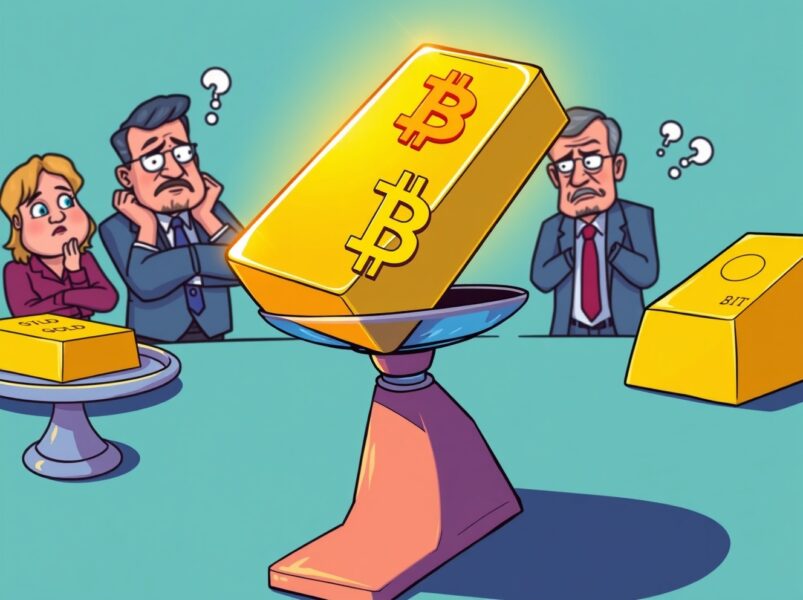
The financial landscape is witnessing a notable divergence between traditional safe havens and their digital counterparts. Gold has reached unprecedented levels this year, while Bitcoin, often referred to as digital gold, faces significant challenges in maintaining key support levels. This situation prompts a reevaluation of Bitcoin”s role in modern investment portfolios.
As market conditions become increasingly volatile, gold has surged, climbing impressively, while silver has seen an even more staggering rise. In contrast, Bitcoin struggles under the weight of profit-taking by investors. This performance gap has emerged during a time of heightened risk aversion, driven by fluctuations in bond yields and the U.S. dollar. Such conditions typically favor traditional assets like gold over more speculative options.
If Bitcoin were to truly embody the characteristics of digital gold, its price movements would reflect a certain resilience in the face of market instability. Instead, the current price action indicates a different reality wherein Bitcoin thrives primarily during periods characterized by accommodative monetary policy and strong risk appetite. Recognizing this behavioral difference is crucial for investors.
According to David Miller, Chief Investment Officer at Catalyst Funds, the distinctions between gold and Bitcoin are pivotal. He asserts that while Bitcoin remains a viable long-term investment, it serves a different purpose than physical gold. Central banks globally regard gold as a foundational reserve asset, ensuring monetary stability. In contrast, Bitcoin is more aligned with retail investors, with its institutional adoption still in its infancy.
Both assets indeed offer hedging capabilities against fiscal expansion and currency devaluation, but they do so through different mechanisms, accompanied by varying volatility profiles. This fundamental difference underscores why gold can effectively replace fiat currencies as a reserve asset, a role that Bitcoin has yet to fulfill.
For investors, this news is not necessarily disheartening for Bitcoin. Instead, it clarifies its position within a diversified portfolio strategy. It is important to consider Bitcoin not merely as digital gold, as such expectations may be unrealistic. Rather, its value lies in its decentralized nature, offering a censorship-resistant store of value that remains uncorrelated to traditional financial systems. This unique trait enables easy transfers and borderless transactions, advantages that physical gold lacks.
The recent market dynamics reveal a more complex truth about Bitcoin“s identity. While it holds potential as a store of value, its performance is more closely linked to liquidity cycles and technological advancements than immediate geopolitical or inflationary pressures. For savvy investors, this divergence presents an opportunity to refine portfolio allocations. Holding gold for its stability during crises while embracing Bitcoin for its growth potential and digital utility can create a well-rounded investment strategy.
In summary, the contrasting performances of Bitcoin and gold invite critical questions about the validity of the digital gold narrative. As investors navigate the evolving landscape, understanding the distinct roles these assets play can facilitate more informed decision-making.
Frequently Asked Questions (FAQs)
- Does Bitcoin”s recent performance mean it”s not a good investment? Not necessarily; it reflects different asset class dynamics.
- Should I sell my Bitcoin to buy gold? It depends on individual investment goals and risk tolerance.
- Will central banks ever buy Bitcoin as a reserve asset? Some smaller nations are exploring this, but major adoption remains uncertain.
- What is the main advantage of Bitcoin over gold? Its portability and verifiability are significant advantages.
- Can both gold and Bitcoin go up in value long-term? Yes, they can rise simultaneously as non-sovereign stores of value.
Engage in the discussion about the ongoing evolution of Bitcoin and its place in the financial world. Share your thoughts on social media and stay updated with the latest trends in cryptocurrency.