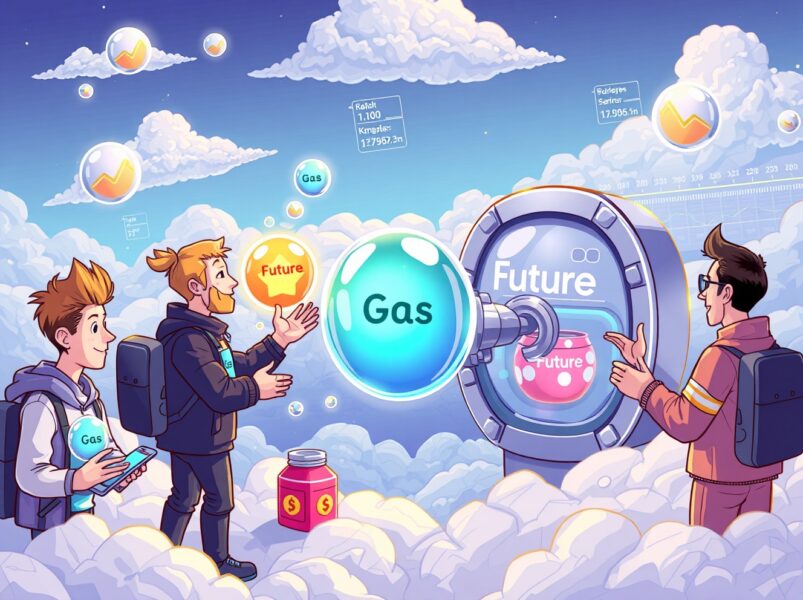
Vitalik Buterin, the co-founder of Ethereum, has put forth a transformative idea aimed at addressing the unpredictable nature of transaction fees on the Ethereum network, commonly referred to as gas fees. This proposal envisions an innovative gas futures market operating directly on the blockchain, which could bring much-needed financial predictability to users and developers alike.
Gas fees on Ethereum are a frequent concern, as they can fluctuate dramatically, presenting challenges for long-term planning and budgeting. By establishing a dedicated gas futures market, Buterin aims to allow users to secure transaction fees at current rates for future use, potentially spanning months or even years. This mechanism would empower individuals and businesses to hedge against uncertain future price movements, thereby enhancing operational stability.
Understanding the Gas Futures Market Concept
A gas futures market operates similarly to other futures markets, where participants can buy or sell contracts for an asset at a predetermined price, with delivery set for a future date. In the context of Ethereum, this would enable users to lock in gas prices today for future transactions. Buterin emphasized that while current fees are manageable, forecasting their movement over the next two years is a daunting task, making this market a timely solution.
Mechanics of an On-Chain Gas Futures Market
The primary purpose of this proposed market would be to facilitate hedging against volatility. Developers launching significant projects or users anticipating increased transaction activity could purchase gas futures contracts, effectively safeguarding themselves against potential spikes in gas prices. If prices were to rise in the future, these users would benefit from having secured their fees at lower rates. On the other hand, if prices decrease, they might incur a minor premium, but the trade-off could be worthwhile for the security it provides.
Implications for Ethereum”s Economic Landscape
Implementing a gas futures market could signify a crucial evolution for Ethereum, shifting its focus from merely enhancing scalability to ensuring economic stability and enabling advanced financial tools. By making Ethereum more appealing to institutional investors and large-scale enterprises requiring predictable costs, this initiative may foster greater adoption of the network.
However, the road to establishing a functional gas futures market is fraught with challenges. Questions remain regarding the specific nature of the contracts—whether they will represent a certain amount of computational gas units or simply the fee price itself. Additionally, creating a secure, decentralized market that remains liquid and resistant to manipulation poses a substantial technical hurdle.
Conclusion: A Vision for the Future
Vitalik Buterin”s proposal for an on-chain gas futures market represents a forward-thinking strategy to alleviate a fundamental issue within the Ethereum ecosystem. By enabling users to hedge against fee volatility, it could lead to a more predictable economic environment, ultimately enhancing interaction with the Ethereum network. While technical complexities must be navigated, the vision points toward a more stable and accessible blockchain landscape.
Frequently Asked Questions
Q: What are gas fees on Ethereum?
A: Gas fees are payments users make to compensate for the computing power required to process and validate transactions or smart contracts on the Ethereum network.
Q: How would a gas futures market benefit the average user?
A: While primarily advantageous for developers, average users could experience indirect benefits through more stable and predictable costs for decentralized applications (dApps) on Ethereum.
Q: Is this market live or just a proposal?
A: Currently, this idea is a proposal from Vitalik Buterin, and no official gas futures market exists on Ethereum at this time.
Q: Would this make gas fees more expensive?
A: Not necessarily. The aim is to facilitate price discovery and risk management, potentially fostering competition and efficiency in pricing future fees.
Q: Can other blockchains implement a similar system?
A: Yes, any blockchain with variable transaction fees could explore the establishment of similar derivative markets to enhance economic predictability for their users.